
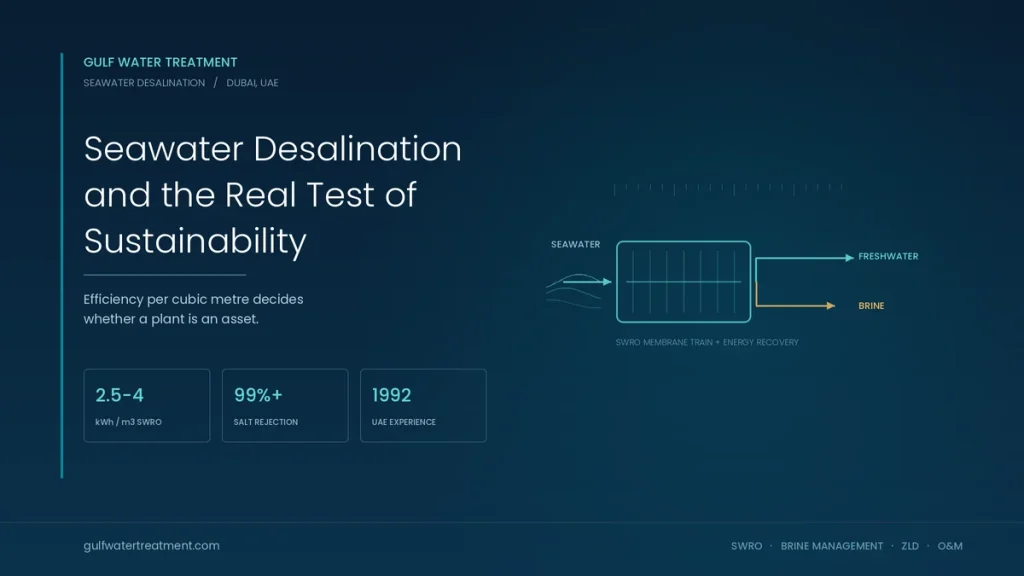
A seawater desalination plant converts seawater into usable freshwater by forcing it through reverse osmosis membranes under pressure. In the UAE it is not a supplementary supply, it is the primary one, and the sustainability question is no longer whether to desalinate but how efficiently. A modern seawater reverse osmosis plant with energy recovery should deliver between 2.5 and 4 kWh per cubic metre at standard seawater salinity. Anything above 5 kWh usually points to a missing energy recovery device, fouled membranes or inefficient pumping. That single number decides whether a plant is a sustainable asset or an expensive liability.
How does a seawater desalination plant work?
Reverse osmosis applies pressure to seawater against a semipermeable membrane, so water molecules pass through while dissolved salts are rejected.
The process produces two streams. Permeate, the freshwater product, which is then remineralised and disinfected to meet drinking or process standards. And brine, the concentrated reject, which must be discharged under consent or processed further.
Around the membranes sit three stages that matter more than most buyers expect.
- Intake and pretreatment. Removes suspended solids, organics and biological load. Poor pretreatment is the leading cause of premature membrane failure.
- High pressure pumping with energy recovery. Recovers pressure energy from the brine stream and returns it to the feed. This is where most of the efficiency gain of the last decade has come from.
- Post treatment. Remineralisation, pH correction and disinfection so the permeate is stable in distribution.
Our seawater reverse osmosis systems are built around all three rather than around the membrane array alone.
Why has reverse osmosis replaced thermal desalination?
Because the energy gap is decisive.
Thermal desalination consumes more than 5 kWh per cubic metre. Reverse osmosis now averages between 2.5 and 3 kWh, and the best performing membrane plants run below that. Across the region, membrane technology has steadily displaced thermal capacity in every new project of scale, and the reason is straightforward. The same volume of water costs far less energy to produce.
For a private developer or industrial operator, the lesson transfers directly. Efficiency is an engineering outcome, not a brand claim. The plant that was specified carefully will run cheaply for twenty years, and the plant that was bought on capital price alone will not.
What makes Gulf seawater harder to desalinate?
Salinity and temperature.
Open ocean seawater sits around 35,000 mg/L total dissolved solids. Arabian Gulf water runs considerably higher, and it is warmer, which increases biological fouling risk. A membrane array specified against generic seawater data will run at higher pressure, lower recovery and shorter membrane life than the proposal promised.
Where salinity climbs beyond standard SWRO territory, a dedicated high saline water treatment system is the correct route. Where the feed is inland groundwater rather than seawater, brackish water reverse osmosis delivers the same output for far less energy.
Is desalination genuinely sustainable?
Honestly, it depends on two things, and the industry does itself no favours by claiming otherwise.
Energy source and efficiency
Desalination is energy intensive by nature, and scaling it globally without decarbonising the electricity behind it simply moves the problem from water scarcity to emissions. A plant running near 3 kWh per cubic metre on renewable power sits in a completely different category from one running above 5 kWh on fossil grid supply.
That is the real sustainability test. Efficiency and energy source are the argument, not the technology label.
Brine management
Reject water is the other half. Options range from consented marine discharge with proper diffusion, through further concentration, to a zero liquid discharge scheme where no liquid effluent leaves the site at all. Brine consent delays more desalination projects than any other single item, and it should be resolved at feasibility stage, not at commissioning.
Desalination should not be the only tool
Treating and reusing wastewater requires a small fraction of the energy that desalination needs. The genuinely sustainable position is a blended one. Desalinate what must be desalinated, and recover everything else through wastewater reuse and TSE polishing. Sites that do both cut their desalination load before they ever size a membrane array.
H2 What are the economic benefits for a UAE operator?
- Supply independence. No exposure to mains interruption, tanker scheduling or connection delays on a new development.
- Predictable cost per cubic metre. Once energy consumption is known and guaranteed, water becomes a modellable line rather than a variable.
- Enabling remote and coastal projects. Resorts, islands, marine operations and remote industrial sites often have no realistic alternative.
- Process reliability. Consistent feed quality for hospitality, food production, boilers and cooling systems.
- Capex flexibility. Build operate transfer and rental systems move the plant off your balance sheet while keeping the water.
What should you ask a seawater desalination plant supplier in Dubai?
Six questions, in order.
- What specific energy consumption do you guarantee at our feed salinity and temperature, in kWh per cubic metre?
- What energy recovery device is specified, and what happens to consumption if it degrades?
- What recovery rate and salt rejection are contractually guaranteed?
- What pretreatment is included, and what is the assumed silt density index of our intake?
- Where does our brine go, and who secures the consent?
- What is the aftermarket position on membranes and spares, held in country?
A supplier that answers all six in writing is engineering the plant. A supplier that answers in adjectives is selling you one.
How Gulf Water Treatment approaches seawater desalination
GWT has been supplying water and wastewater systems in the UAE since 1992, with more than 2,000 units installed across the region for developers, ports, industrial operators and municipal authorities.
Projects usually start with a consultancy and feasibility study covering feed analysis, demand profile, brine route and energy modelling, then move through turnkey project execution and into a long term operations and maintenance contract, which is what holds efficiency at the guaranteed level over the plant’s life. Our case studies show how this works in practice across desalination and large scale pumping projects.
Frequently asked questions
How much energy does seawater desalination use?
A modern seawater RO plant with energy recovery should run between 2.5 and 4 kWh per cubic metre at standard seawater salinity, with figures above 5 kWh indicating a problem. Gulf salinity pushes the requirement toward the upper part of that band.
Is desalinated water safe to drink?
Yes, once post treated. RO permeate is very low in minerals, so it is remineralised and disinfected before distribution to meet potable standards and to remain stable in the network.
What happens to the brine from a desalination plant?
It is discharged under consent with proper dilution, concentrated further, or eliminated entirely through a zero liquid discharge process. The route must be agreed before design is finalised.
How long does a seawater desalination plant take to build?
It depends on capacity, site conditions and approvals rather than on a standard timeline. Consenting and intake works usually drive the programme more than the treatment train itself.
Can solar power run a desalination plant?
Yes. Reverse osmosis pairs well with photovoltaic supply because it runs on electricity rather than heat, and on site solar can cut the energy cost that dominates operating expenditure.
Every site has a different feed salinity, demand curve and brine route, so the specification has to start from your data. Talk to our engineering team for a feasibility assessment on your project.