
What Is Water Treatment and Why Does It Matter?
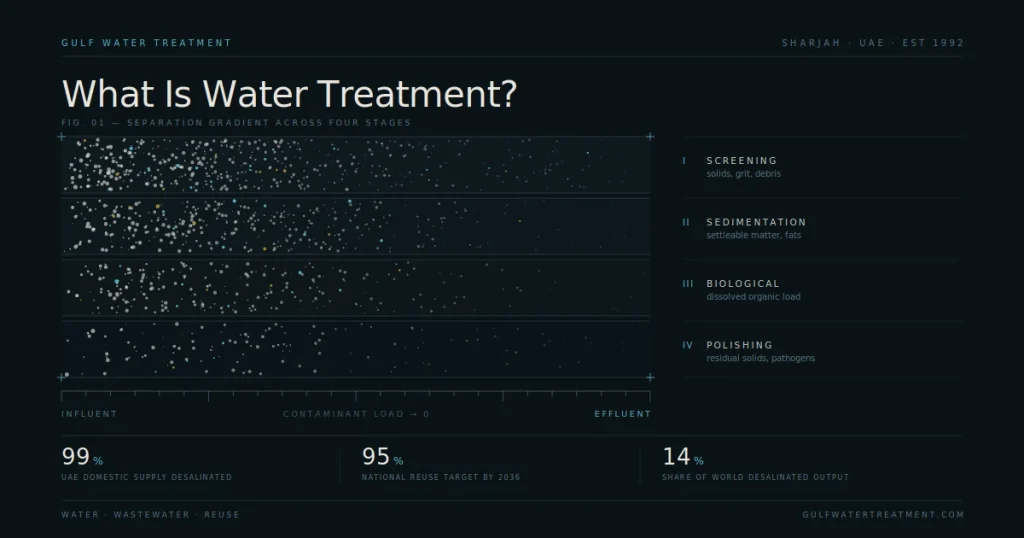
Around 99% of the UAE’s domestic water supply comes from desalinated seawater. Almost none of the water anyone here drinks, cooks with or showers in existed as fresh water before it was treated.
That single fact explains why water treatment is not a background utility in this country. It is the supply.
What Is Water Treatment?
Water treatment is the process of removing contaminants from water so it is safe to use, safe to discharge, or clean enough to reuse. The contaminants removed depend entirely on where the water came from and what it is going to be used for.
The same phrase covers four quite different jobs. Turning seawater into usable water is water treatment. Cleaning factory effluent before it goes down a drain is water treatment. So is polishing treated sewage until it is fit to irrigate a park.
What they share is a sequence. Remove what will damage the next stage, separate the solids, deal with what is dissolved, then bring the output to whatever standard its end use demands.
What Are the Main Types of Water Treatment?
Water treatment splits into four categories, defined by the source of the water and the standard the output has to meet. Most industrial and commercial sites in the UAE need at least two of them running at the same time.
| Type | Input | Output used for | Typical technology |
|---|---|---|---|
| Water treatment | Seawater, brackish groundwater, river or dam water | Process water, boiler feed, potable supply | Reverse osmosis, filtration, demineralisation |
| Sewage treatment | Domestic wastewater from toilets, kitchens, showers | Irrigation, cooling, flushing | Biological treatment, filtration, disinfection |
| Effluent treatment | Industrial process wastewater | Discharge or process reuse | Chemical dosing, flotation, biological treatment |
| Water reuse and polishing | Already-treated wastewater | Unrestricted irrigation, district cooling | Membrane filtration, advanced oxidation, UV |
A factory typically runs all four. Treated feed water for the process, an effluent treatment plant for what the line produces, a sewage treatment plant for the offices and welfare block, and TSE polishing if the treated output is going back onto the landscaping.
They are separate systems handling separate streams. Combining them is usually a design error rather than a saving.
Why Does Water Need Treating in the First Place?
Water needs treating because no naturally occurring water source in the UAE is fit for its intended use without it, and no used water is fit to release without it. The reasons split into three.
Health. Untreated water carries pathogens. This is the oldest reason for treating water and it is still the one that matters most in any application where people come into contact with the output.
Protection of what the water touches. Industrial water damages equipment before it damages anything else. Scale forms in boilers, membranes foul, heat exchangers lose efficiency and pipework corrodes. Treating feed water is usually cheaper than replacing the equipment that untreated water destroys.
Protection of what receives the discharge. Untreated effluent entering the sea or the ground carries organic load that strips out dissolved oxygen, plus whatever chemicals the process put into it. Both effects are immediate and neither reverses easily.
In the UAE there is a fourth reason that outweighs the first three commercially. Water costs money to produce. Every cubic metre recovered and reused is a cubic metre that does not have to be desalinated and bought.
Why Does Water Treatment Matter So Much in the UAE?
Because the UAE has almost no usable natural fresh water, and everything else has to be manufactured or recovered. The numbers make the position clear.
The UAE holds roughly 640 billion cubic metres of groundwater, but only about 3% of it is fresh, which comes to around 20 billion cubic metres. Domestic supply therefore depends almost entirely on desalination, at around 99%, and in Dubai desalination provides more than 95% of municipal water.
That dependence is regionally normal and industrially significant. More than 400 desalination plants operate along the Arabian Gulf coast, and eight of the ten largest desalination plants in the world sit on the Arabian Peninsula. The UAE is the second largest desalination market globally after Saudi Arabia and produces around 14% of the world’s desalinated water.
Desalination is expensive and energy intensive, which is what makes the second half of the picture matter. Treated wastewater replaces desalinated water for everything that does not need drinking quality. Dubai reuses more than 90% of its treated effluent for landscape irrigation, parks, aquifer recharge and district cooling, and that reuse cuts the city’s non-potable desalinated demand by 700 million litres a day.
The UAE National Water Security Strategy 2036 targets 95% reuse of treated water. For any site operating its own treatment plant, the same economics apply at a smaller scale. Water treated and reused on site is water that never appears on a bill.
What Is the Difference Between Water Treatment and Wastewater Treatment?
Water treatment makes water usable. Wastewater treatment makes used water safe to release or reuse. The distinction is direction of travel, not technology, and the same equipment often appears in both.
Water treatment takes a raw source such as seawater, brackish groundwater or surface water and produces water fit for a defined use. Reverse osmosis, filtration and demineralisation do most of the work.
Wastewater treatment takes water that has already been used and removes what the use put into it. Biological treatment does most of the work here, because the contaminants are largely organic.
The confusion is understandable because the two meet in the middle. A reuse plant takes treated wastewater and applies water treatment technology to it, producing something clean enough for applications the original wastewater plant was never designed to serve.
Who Needs Water Treatment?
Any site that either takes in water that is not fit for its process, or produces water that is not fit to release. In practice across the UAE that covers most commercial and industrial operations.
- Hotels and hospitality. Sewage treatment plus treated effluent recovered onto landscaping and cooling.
- Hospitals and healthcare. Higher disinfection standards on both supply and discharge.
- Manufacturing and industry. Process water treatment at the inlet, effluent treatment at the outlet, and often both in the same building.
- Oil and gas. Produced water treatment, high salinity streams and process water, usually at scale.
- Commercial and residential developments. Sewage treatment, greywater recovery and irrigation reuse.
- Municipalities. Everything above, at utility scale.
The industries GWT works in covers how requirements differ by sector, since the contaminant profile changes far more between industries than the volume does.
How Do You Know What Treatment You Actually Need?
Treatment selection starts with two tests, one on the water going in and one on what the output has to achieve. Everything else follows from those two answers.
Four questions establish the scope.
- Where is the water coming from? Seawater, groundwater, municipal supply and recovered effluent all behave differently and need different pre-treatment.
- What is the water going to be used for? Boiler feed, process water, irrigation and discharge are four different standards, not one.
- What is the flow profile? Steady, batched or seasonal changes which technologies work, sometimes more than the volume does.
- Who operates it? A plant needing daily technical attention is the wrong answer for a site without a technician.
A supplier quoting before answering those four is guessing. GWT runs the assessment as a standalone consultancy and feasibility service, independent of whether anything is bought afterwards.
Frequently Asked Questions
What is water treatment in simple terms?
Water treatment removes contaminants from water so it is safe to use, safe to discharge or clean enough to reuse. Which contaminants get removed depends on where the water came from and what it will be used for.
What are the main stages of water treatment?
Most treatment follows the same order. Remove large solids first, separate suspended solids next, then address dissolved contaminants, then bring the output to the standard the end use requires through filtration and disinfection.
Is treated water safe to drink?
It depends on the standard it was treated to. Desalinated water is treated to potable standard. Treated sewage effluent is not potable and is used only for irrigation, cooling, dust suppression and flushing.
What is the difference between water treatment and water purification?
The terms overlap. Water treatment is the broader term covering any process that makes water fit for purpose, including treating wastewater. Purification usually refers specifically to producing high-purity water for drinking or process use.
Why is water treatment important in the UAE?
The UAE has very limited fresh groundwater and depends on desalination for around 99% of domestic supply. Treating and reusing wastewater reduces how much water has to be desalinated, which is why the National Water Security Strategy 2036 targets 95% reuse of treated water.
How much does water treatment cost?
Cost is driven by volume, source water quality, the standard the output must meet and the technology that follows from those. A plant treating to discharge standard costs considerably less than one treating to unrestricted reuse standard at the same capacity.