
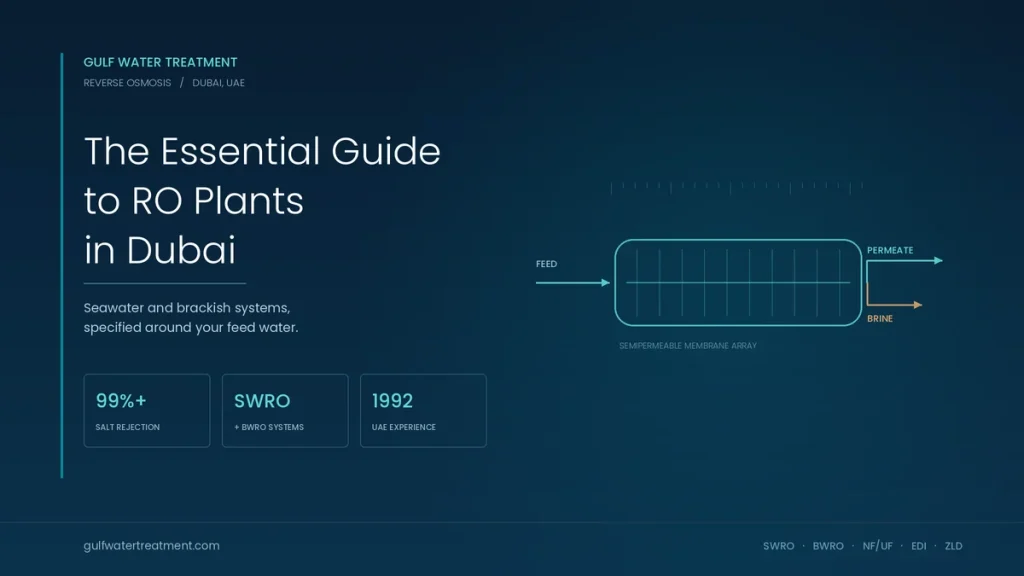
An RO plant in Dubai is a reverse osmosis system that pushes feed water through a semipermeable membrane under pressure, separating dissolved salts, minerals and contaminants from clean permeate. In the UAE the feed is usually Gulf seawater, brackish groundwater or recycled process water, and the plant is sized around the salinity of that feed rather than around the building it serves. Choosing the wrong feed classification is the single most common and most expensive mistake buyers make.
This guide covers how the technology works, which RO system matches which feed water, what drives cost, and what to check before appointing a supplier. Gulf Water Treatment has been building these systems in the UAE since 1992, with more than 2,000 units installed across the region.
How does reverse osmosis actually work?
Reverse osmosis reverses natural osmotic flow using applied pressure.
Under normal osmosis, water moves from a low salt concentration to a high one. An RO plant applies pressure to the salty side, forcing water molecules through a membrane with pores small enough to reject dissolved salts, heavy metals, bacteria and most organic compounds. Two streams leave the system. Permeate, which is the treated water you use, and reject or brine, which carries the concentrated salts away.
Three numbers define how the plant behaves.
- Recovery rate. The share of feed water converted to permeate. Seawater systems typically recover far less than brackish systems because the feed is so much saltier.
- Salt rejection. The percentage of dissolved solids the membrane removes, usually well above 99 percent on a healthy system.
- Specific energy consumption. The kWh needed per cubic metre produced, which is the main driver of your operating cost.
RO rarely runs alone. Pretreatment, and often post treatment such as remineralisation or UV and fine filtration within a broader water treatment system, decides whether the membranes last five years or fail in eighteen months.
Which type of RO plant do you need in Dubai?
This depends entirely on your feed water, not on your industry.
| Feed water | System | Typical application |
|---|---|---|
| Gulf seawater, very high salinity | Seawater Reverse Osmosis (SWRO) | Coastal developments, marine, resorts, remote sites with no mains supply |
| Brackish groundwater or well water | Brackish Water Reverse Osmosis (BWRO) | Inland facilities, irrigation, labour accommodation, light industry |
| Mains water needing polishing | Nano Filtration (NF) & Ultra Filtration (UF) | Food and beverage, hospitality, pre-RO protection |
| Ultra pure requirement | Electro Deionization | Pharmaceuticals, power, boiler feed, electronics |
| Extreme salinity or brine streams | High Saline Water Treatment | Oil and gas, industrial reject management, ZLD schemes |
The Arabian Gulf is one of the most saline bodies of water in the world, with salinity well above open ocean levels. A membrane array specified against generic seawater data will underperform here. Any credible proposal starts with a lab analysis of your actual feed.
What does an RO plant in Dubai cost to own?
Capital price is the smallest part of the answer.
Utility scale desalination projects in the region now achieve levelised water tariffs well under half a dollar per cubic metre, which shows what is technically possible at enormous volume. A private plant will sit above that, and where it lands depends on four things.
- Feed salinity. Higher salinity means higher pressure, higher energy, lower recovery.
- Energy recovery devices. On SWRO these cut specific energy consumption substantially and usually pay back inside the first years.
- Pretreatment quality. Poor pretreatment shortens membrane life and multiplies chemical cleaning cycles.
- Operating discipline. Monitored plants under a proper operations and maintenance contract hold their performance. Unmonitored plants lose output gradually until someone notices the bills.
If capital budget is the constraint rather than the need, rental systems and build operate transfer arrangements move the plant off your balance sheet while keeping the water supply.
What are the real benefits for a commercial or industrial site?
- Independent supply. A site with its own RO plant is not exposed to mains interruption, tanker scheduling or connection delays on a new development.
- Process consistency. Food, beverage, pharmaceutical and boiler applications need water within a defined specification, every shift, not on average.
- Asset protection. Controlled feed quality reduces scaling and corrosion in boilers, chillers, cooling towers and pipework.
- Lower disposal load. Treated and recovered water reduces both intake volume and discharge volume.
- Compliance evidence. A monitored plant produces the quality records authorities and auditors ask for.
For hotels and resorts, the case is usually supply security and guest experience. See how this plays out in hospitality and in food and beverage facilities.
How do you specify the right RO plant?
Work through these in order. Skipping step one invalidates everything after it.
- Feed water analysis. Full ionic breakdown, TDS, silt density index, temperature range, seasonal variation.
- Permeate specification. What the water must meet at point of use, written as numbers, not as “clean” or “potable”.
- Demand profile. Peak daily volume, average volume, and how much storage buffers the gap.
- Reject management. Where brine goes, and whether discharge consent exists. This kills more projects late than any other item.
- Footprint and utilities. Space, power availability, chemical storage, access for membrane replacement.
- Redundancy. Whether a single train outage is tolerable or whether you need N plus one.
A consultancy and feasibility study covers all six before capital is committed, which is considerably cheaper than discovering item four after commissioning.
How do you choose an RO plant supplier in Dubai?
Five checks separate engineering companies from resellers.
- Comparable references. Ask for installed plants on similar feed water at similar capacity, and ask to visit one. GWT’s case studies include river water desalination and large municipal pumping works.
- Guaranteed performance. Permeate quality, recovery and energy consumption written into the contract, not quoted verbally.
- In-country aftermarket. Spare parts and chemicals and consumables held locally, with defined response times. An imported membrane on a six week lead time is a six week outage.
- Retrofit capability. Whether they can repair, refurbish and retrofit an existing plant, or only sell you a new one.
- Track record and approvals. Years in the UAE market, and a client list you can verify.
Frequently asked questions
What is the difference between an RO plant and a desalination plant?
Desalination is the objective, removing salt from water. Reverse osmosis is the most widely used method of achieving it. Most modern desalination plants in the UAE are RO plants.
How long do RO membranes last?
Membrane life depends on feed quality, pretreatment and cleaning regime rather than on a fixed calendar. Well maintained systems run for several years per element, while poorly pretreated systems fail far sooner.
Can an RO plant treat Gulf seawater directly?
Yes, with a seawater specific system. Gulf seawater is unusually saline and warm, so the membrane array, pressure rating and pretreatment must be designed for those conditions specifically.
What happens to the brine from an RO plant?
Reject water must be discharged under consent or processed further. Options include approved marine or sewer discharge, further concentration, or a zero liquid discharge scheme where no liquid effluent leaves the site.
Is an RO plant worth it for a smaller facility?
It depends on your volume, your feed source and your alternative supply cost. A feasibility assessment will answer it with your own numbers rather than a rule of thumb.
Every site has a different feed water and a different demand curve, so the specification has to start from your analysis. Talk to our engineering team and we will size the right RO system for your project.