
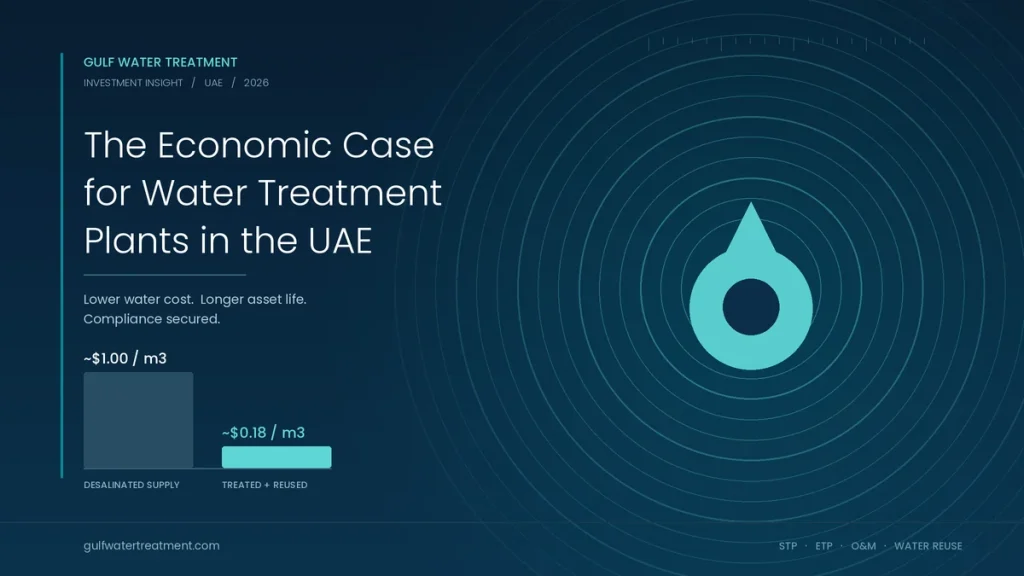
Investing in a water treatment plant in the Gulf pays back through four measurable channels. Lower water procurement cost, longer asset life, protection against supply and tariff shocks, and compliance value that keeps a facility operating without penalty. For most industrial and commercial sites in the UAE, reusing treated water in place of desalinated supply is the largest single line of saving, and it is the reason established water treatment plant manufacturers in Dubai now design almost every new facility around reuse from day one.
How much does water treatment actually save in the UAE?
The saving comes from the price gap between desalinated water and treated water.
Recycled water has historically cost the region a fraction of what desalinated water costs to produce. Industry benchmarks put treated sewage effluent at roughly $0.15 to $0.20 per cubic metre against about $1 per cubic metre for desalinated water. Utility scale desalination projects can push their levelised tariff well below that dollar mark, but those figures reflect enormous plants built on long term offtake agreements, not the price an individual factory or compound pays.
| Cost driver | Without on-site treatment | With on-site treatment and reuse |
|---|---|---|
| Process and irrigation water | Purchased potable or desalinated supply | Reused treated effluent at a fraction of the cost |
| Discharge and tanker fees | Recurring, volume based | Reduced or removed |
| Scale, corrosion and fouling | Higher maintenance and downtime | Controlled feed quality, longer asset life |
| Regulatory exposure | Fines and stop notices | Documented compliance |
Industrial sites carrying a heavier contaminant load usually reach this position through a dedicated effluent treatment plant rather than a standard domestic process train. A district cooling plant, a labour accommodation, a food factory and a landscaped development all follow the same logic. The water they discharge is the cheapest water they will ever buy back.
Why is the payback stronger in the Gulf than elsewhere?
Because the alternative is expensive and energy intensive.
The UAE now has more than 160 wastewater treatment plants with combined capacity above 3 million cubic metres per day, and around 73 percent of treated wastewater is used for landscape irrigation. That still leaves a gap. The UAE produces roughly 735 million cubic metres of treated sewage effluent each year, about 11 percent of national water demand, and more than a quarter of it is lost or discharged to sea. Every cubic metre discharged is a cubic metre a developer or operator has to replace with desalinated water.
Every cubic metre discharged is a cubic metre a developer or operator has to replace with desalinated water. A correctly sized sewage treatment plant in UAE closes that loop on site, which is why payback periods here are shorter than in regions with cheap surface water.
What does the UAE Water Security Strategy 2036 mean for investors?
It turns reuse from a voluntary saving into a planning assumption.
The strategy targets a 21 percent reduction in total water demand and a rise in treated water reuse to 95 percent by 2036. Abu Dhabi is moving faster still, treating more than one million cubic metres per day with about 80 percent already reused and a target of 100 percent reuse by the end of 2026.
For a business planning a 15 to 25 year facility, the direction of travel is settled. Sites designed today for reuse will meet tomorrow’s rules without a retrofit. Sites designed for discharge will pay twice.
Which costs fall first after commissioning?
In order of how quickly they show up on the P&L:
- Water purchase and tanker costs. Immediate, from the first month of stable operation.
- Discharge and disposal charges. Immediate, where effluent was previously trucked or paid out.
- Chemical and energy cost per cubic metre. Within the first year, once the process is tuned to the actual load rather than the design load.
- Maintenance and replacement of pipework, boilers, chillers and membranes. Over two to five years, as controlled feed quality reduces scaling and corrosion.
- Downtime and compliance risk. Ongoing, and usually the largest hidden cost avoided.
Items three, four and five are won or lost after handover, not during construction, which makes the plant operation and maintenance contract as commercially important as the capital build itself.
Does the treatment level change the economics?
Yes, and this is where most budgets are lost.
Matching the treatment standard to the end use is the single biggest lever on lifecycle cost. Membrane bioreactor systems combine biological treatment with membrane filtration to produce effluent suitable for unrestricted irrigation and sensitive industrial reuse, with ultrafiltration and reverse osmosis added only where the application requires further polishing. Over specifying pushes energy and chemical cost up for no commercial return. Under specifying risks a plant that cannot legally serve the use it was built for.
Dubai Municipality and the Abu Dhabi authorities publish their own effluent quality guidelines within a federal framework, and requirements differ between restricted irrigation, unrestricted agricultural use and industrial cooling. The design brief should start from the reuse application, never from a generic package.
What are the wider economic and social returns?
- Reduced pressure on desalination, which lowers energy demand and the carbon footprint attached to every cubic metre supplied.
- Protected marine environment, since a large volume of treated sewage water is still discharged into the sea across the region and the Gulf is already a high salinity, low exchange body of water.
- Local employment, across construction, operations, laboratory testing and O&M contracts.
- Public health and productivity gains, from reliable sanitation and safe reuse standards.
- Asset and tenant value, as ESG reporting and green building certification increasingly require documented water performance.
How do you judge a water treatment plant manufacturer in the UAE?
Ask for five things before signing.
- Reference plants of similar load and similar reuse application, with permission to visit.
- Guaranteed effluent quality written against the specific standard for your intended reuse.
- A modelled operating cost per cubic metre, not just a capital price.
- In-country O&M capability, spares holding and response times.
- Approvals history with the relevant municipality or authority for your emirate.
Capital cost is the smallest part of a 20 year ownership cost. Operating cost, uptime and compliance decide whether the investment actually returns. Experienced water treatment plant manufacturers in Dubai will put all five in writing before you commit.
Frequently asked questions
Is a sewage treatment plant a good investment for a private development?
Yes, where the site generates a steady effluent volume and has an on-site reuse demand such as irrigation, cooling or flushing. Payback is driven by displaced water purchases and avoided discharge charges.
What is the typical payback period for an STP or ETP in the UAE?
It depends on water volume, tariff exposure and reuse route. Sites with high irrigation or cooling demand generally see the fastest return, since they displace the most expensive water they buy.
Can treated wastewater be used for drinking in the UAE?
Reuse is regulated by application, and the common permitted uses are irrigation, landscaping, district cooling and industrial process water rather than potable supply.
What is the difference between an STP and an ETP?
An STP treats domestic sewage. An ETP treats industrial effluent, which usually carries a different contaminant profile and needs a tailored process train.
Every site has a different water balance, so the only way to know your real payback is to model it against your actual volumes and tariffs. Contact our team for a site assessment and we will build the numbers with you.