
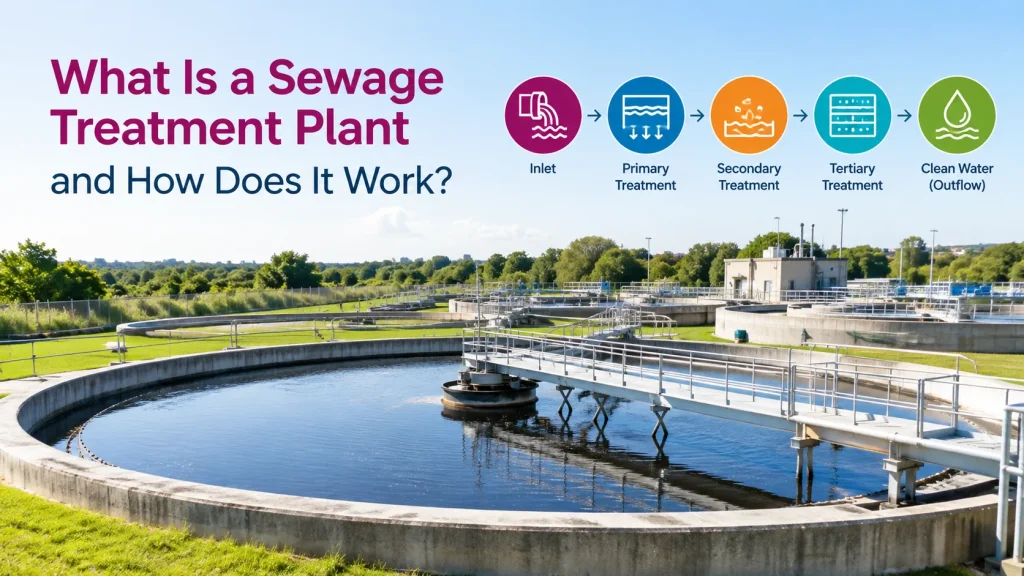
Every litre of water that leaves a toilet, shower, kitchen sink or washing machine has to go somewhere. In the UAE, most of it ends up at a sewage treatment plant, and most of it comes back out as irrigation water.
This is what happens in between.
What Is a Sewage Treatment Plant?
A sewage treatment plant is a facility that removes solids, organic matter and pathogens from domestic wastewater so the treated output can be discharged safely or reused. It does this across four stages, using physical separation, biological digestion and chemical disinfection in sequence.
The input is sewage. The two outputs are treated water, called treated sewage effluent or TSE, and sludge.
Sewage treatment plants are built at every scale. A single hotel might run one treating 200 cubic metres a day. At the other end, Dubai Municipality’s Jebel Ali plant was planned to reach an ultimate capacity of 1,050,000 cubic metres a day, serving the Jebel Ali industrial area and Dubai South.
A sewage treatment plant treats domestic sewage. Industrial process wastewater is a different problem with a different contaminant profile, and it goes to an effluent treatment plant instead.
Why Does Sewage Need Treating At All?
Untreated sewage carries pathogens that spread disease and organic matter that strips oxygen out of any water body it enters. Both effects are immediate and neither is reversible once the discharge has happened.
The oxygen effect is the one most people miss. Bacteria in a river or sea consume organic matter using dissolved oxygen. Release enough untreated sewage and those bacteria consume the oxygen that fish and marine life need. The water looks fine and nothing lives in it.
In the UAE there is a third reason that outweighs both. Water is scarce and desalination is expensive. Treated sewage effluent replaces desalinated water for every application that does not require drinking quality. Dubai’s reuse programme cuts the city’s use of desalinated seawater for non-potable purposes by 700 million litres a day.
How Does a Sewage Treatment Plant Work, Stage by Stage?
A sewage treatment plant works in four stages. Preliminary treatment removes debris and grit, primary treatment settles out solids, secondary treatment digests dissolved organic matter biologically, and tertiary treatment filters and disinfects the remaining water.
Each stage removes a different class of contaminant, and each one exists because the stage after it cannot handle what the stage before it takes out.
What Does Preliminary Treatment Remove?
Screens and grit chambers remove what should never have entered the sewer in the first place. Rags, wet wipes, plastics, sand and grit.
Coarse screens catch the large material. Fine screens catch what gets past them. Grit chambers slow the flow so sand and gravel settle out while lighter organic matter stays suspended.
This stage protects everything downstream. Grit wears out pumps, rags block impellers and wipes wrap around rotating equipment. It is also the stage most often undersized, and undersized screening is one of the most common faults found when retrofitting an existing plant.
What Happens During Primary Treatment?
Sewage enters large sedimentation tanks, also called primary clarifiers, and sits.
Gravity does the work. Heavier solids sink to form primary sludge. Lighter material, mostly fats, oils and grease, floats to the surface as scum. Both are scraped off, leaving partially clarified water in the middle.
Primary treatment removes a substantial share of the suspended solids before any biology is involved, which lowers the load the secondary stage has to carry.
How Does Secondary Treatment Clean the Water?
Secondary treatment is biological. Micro-organisms consume the dissolved and fine suspended organic matter that settlement cannot remove.
This is where most of the contaminant removal happens, and it is explained in more detail in the next section.
The biomass that grows during this process is separated from the treated water in a secondary clarifier or by membrane filtration, depending on the technology used. Some of it is returned to the process to maintain the population, and the excess joins the sludge line.
What Is Tertiary Treatment For?
Tertiary treatment is polishing. It takes water that has already had its organic load removed and brings it to the standard the intended reuse requires.
Sand filtration or membrane filtration removes residual suspended solids. Disinfection by UV light or chlorination inactivates the remaining pathogens. Jebel Ali uses sand filtration followed by UV to produce effluent suitable for unrestricted reuse to Dubai Municipality irrigation standards.
Where the reuse grade is higher than the plant produces, a separate TSE polishing plant is added downstream.
What Gets Removed at Each Stage?
The table below sets out which contaminant each stage targets and what removes it.
| Stage | Removes | How |
|---|---|---|
| Preliminary | Rags, plastics, sand, grit | Coarse and fine screens, grit chambers |
| Primary | Settleable solids, fats, oils, grease | Gravity settlement, surface skimming |
| Secondary | Dissolved and fine suspended organic matter, BOD, COD | Biological digestion, then clarification or membrane separation |
| Tertiary | Residual solids, pathogens, colour | Sand or membrane filtration, UV or chlorine disinfection |
Removing a stage does not shift its work to the next one. Each stage only functions if the one before it has done its job, which is why a plant with blocked screens fails biologically even though screening is not a biological process.
What Actually Does the Cleaning Inside a Sewage Treatment Plant?
Bacteria do the cleaning. A sewage treatment plant is a container built to keep a specific bacterial population alive, fed and supplied with oxygen while it consumes the organic matter in the sewage.
Everything else in the plant exists to support that population or to separate it from the water afterwards.
The bacteria consume dissolved organic matter as food. To do it they need oxygen, which is why blowers and diffusers run continuously in an aerated plant. Cut the air and the population dies within hours. Restarting it takes days.
Three things keep the population stable.
- Oxygen supply. Delivered by blowers through diffuser grids or aeration systems. The largest single energy cost in most plants.
- Food supply. Steady organic loading. Long shutdowns starve the population, which is why campus and school plants need designing differently from a hotel.
- Somewhere to live. Free-floating in the water in an activated sludge system, attached to plastic carriers in an MBBR, or attached to fixed media in a SAFF system.
The secondary treatment technology a plant uses is essentially a decision about how to house and separate that population. The technology comparison on the STP page sets out what each approach trades away.
What Happens to the Sludge?
Sludge is the solid by-product of sewage treatment, made up of the settled solids from primary treatment and the excess biomass from secondary treatment. Every plant produces it, and handling it is a permanent operating cost rather than a one-off.
Raw sludge is mostly water. The first job is removing that water, because volume drives every downstream cost.
- Thickening concentrates the sludge and reduces its volume before further processing.
- Dewatering removes most of the remaining water mechanically, using a belt press, filter press, screw press or centrifuge.
- Digestion breaks down the organic content further, and anaerobic digestion produces methane as a by-product.
- Drying takes the dewatered solids to a state where they can be handled, transported and disposed of or reused.
Jebel Ali is a useful example of the scale involved. Its sludge is anaerobically digested, and the methane produced is used as fuel to evaporate the remaining water. The drying plant handles 453 tons of sludge per day, taking dewatered sludge from 22% dry solids to 92%.
Most commercial and industrial plants do not digest sludge on site. They dewater it and remove it. The choice of dewatering method is driven by sludge volume and available space, which is why two plants of the same capacity can carry different equipment.
How Do You Know If a Sewage Treatment Plant Is Working?
A sewage treatment plant is working if the treated effluent meets the limits set for its intended discharge or reuse, measured on BOD, COD, TSS, pH and faecal coliform. These are laboratory measurements taken on the output, not observations of the plant itself.
Here is what each one means.
- BOD, biochemical oxygen demand, measures the oxygen bacteria would consume breaking down the organic matter still in the water. High BOD means organic load got through the biological stage.
- COD, chemical oxygen demand, measures total oxidisable matter, including compounds bacteria cannot digest. COD is always higher than BOD, and the gap between them indicates how much of the remaining load is non-biodegradable.
- TSS, total suspended solids, measures undissolved particles. High TSS usually points to a clarification or filtration problem rather than a biological one.
- pH affects whether the bacteria can function at all and whether the effluent is safe to discharge.
- Faecal coliform indicates whether disinfection has worked.
In the UAE, the applicable limits are set by the authority for the emirate the plant operates in. Dubai Municipality, Sharjah Municipality and the Environment Agency Abu Dhabi each publish their own, and the threshold tightens as the intended reuse moves from restricted irrigation toward unrestricted use.
A plant passing at commissioning tells you the design was right. A plant still passing three years later tells you it is being operated and maintained properly.
Is a Septic Tank the Same as a Sewage Treatment Plant?
No. A septic tank separates solids from liquid and holds them. A sewage treatment plant actively treats the water and produces an effluent clean enough to discharge or reuse.
A septic tank has no aeration, no bacterial population maintained on purpose and no disinfection stage. Its liquid output still carries most of the original organic load and has to go to a soakaway or be tankered out. Its solids accumulate until they are pumped.
A sewage treatment plant does all four stages and produces a measurable effluent quality. The difference is not scale, it is whether treatment happens at all.
Where Does Treated Sewage Go in the UAE?
Most treated sewage effluent in the UAE is reused rather than discharged. It irrigates landscaping, parks and roadside planting, feeds district cooling systems, suppresses dust on construction sites and flushes toilets in buildings plumbed for it.
The scale is significant. Dubai Municipality’s Warsan and Jebel Ali plants together reached a combined capacity of around one million cubic metres per day, and the Jebel Ali Phase 2 expansion alone cost Dh1.3 billion. Between them the facilities handle the equivalent of the sewage flow from a city of 3.35 million people.
That reuse displaces desalinated water. Cutting 700 million litres a day of non-potable desalinated demand is a direct energy and cost saving, and it is the reason the UAE National Water Security Strategy 2036 targets 95% reuse of treated water.
For a building or site with its own plant, the same logic applies at a smaller scale. Treated effluent used on site for irrigation or cooling is water that does not have to be bought.
Why Do Sewage Treatment Plants Fail?
Most sewage treatment plants that fail their effluent test were built correctly and maintained badly. Failure is gradual, and the plant usually looks like it is running right up until the laboratory result comes back.
The common causes are consistent across sites.
- Blowers degrading. Air output falls slowly. The bacterial population shrinks with it, and BOD removal drops before anything sounds wrong.
- Media or membrane fouling. Reduces the active surface the biology lives on, or the flux through a membrane.
- Dosing drift. Chemical dosing set at commissioning stops matching the actual load as site occupancy changes.
- Sludge accumulation. Sludge not removed on schedule reduces effective tank volume and carries over into the effluent.
- Load change. A building extension, an occupancy increase or a new kitchen changes what arrives at the plant without anyone changing the plant.
- Tightened limits. A plant that met the standard when installed no longer meets the current one.
Only the last two are design problems. The rest are maintenance problems, which is why plants under a scheduled operation and maintenance contract hold their standard longer than plants serviced reactively.
Where the civil structure remains sound, a failing plant rarely needs replacing. Targeted retrofits and upgrades restore performance at a fraction of the cost of a new plant.
Sewage Treatment Plant FAQs
What is STP in water treatment? STP stands for sewage treatment plant. It removes solids, organic matter and pathogens from domestic wastewater across four stages so the output can be discharged or reused for irrigation, cooling or flushing.
How many types of sewage treatment plant are there? Plants are classified by their secondary treatment technology. The five in common use across the UAE are MBBR, MBR, SBR, extended aeration and SAFF. They are supplied as containerised, packaged, skid-mounted, civil-built or marine systems.
What is STP water used for? Treated sewage effluent is used for landscape irrigation, district cooling, dust suppression, construction and toilet flushing. It is not potable and is not plumbed into drinking water supply.
How long does sewage take to pass through a treatment plant? Retention time depends on the technology and the design load. Secondary biological treatment is the longest stage, because the bacterial population needs contact time with the organic matter to digest it.
What is the difference between an STP and an ETP? An STP treats domestic sewage from toilets, kitchens, showers and laundry. An effluent treatment plant treats industrial process wastewater, which carries industry-specific contaminants and needs a treatment train built around them.
Can sewage treatment plants be installed inside a building? Yes. Skid-mounted and packaged plants are designed to fit inside plant rooms and basements. Footprint is one of the main factors in choosing between treatment technologies, since an MBR plant occupies considerably less space than an extended aeration plant of the same capacity.
Talk to GWT About Your Plant
GWT has designed, built and maintained sewage treatment plants across the UAE since 1992. If you are planning a new plant, or your existing one is drifting out of spec, an assessment establishes where it stands before anything is quoted.